Kalima for Healthcare Teams
Care teams work fast and under pressure, and spoken details still have to stay clear across shifts, roles, and languages. Kalima captures that conversation while the work is happening, so nothing important lives only in someone's memory.
This page is about operational communication: handovers, coordination, training, lectures, and conversations that cross languages. Kalima is a transcription tool rather than a clinical system, and the questions below say plainly what that rules out.

Communication breaks down when important context stays only in speech
Shift updates, coordination calls, case discussions, and conversations across languages all carry risk when people remember the details differently.
Kalima gives those moments a clear written record. Follow-up gets easier, and colleagues coming on shift or working in a second language have a faster way to catch up.
Where care communication loses clarity
Most teams feel the problem during handoffs and follow-up. The conversation is over in minutes, but the need to review it accurately lasts much longer.
Shift handoffs carry high stakes
When operational details are passed along by voice, a small gap in recall can cause real confusion. A written transcript keeps the thread intact between shifts.
Follow-up needs clear written context
Teams often have to revisit what was said after a conversation ends, especially when the next shift or another department needs the same context.
Working across languages adds friction
Staff, patients, and families in the same building often do not share a language. A translated live transcript helps people follow what is being said. For consent, diagnosis, and discharge instructions, a qualified interpreter is still the requirement.
How healthcare teams use Kalima
The workflows that help most are simple. Keep the conversation clear, hold continuity between shifts, and make review easy for everyone involved.
Capture multidisciplinary discussions
Record team conversations so the key details are easy to review and act on across roles, departments, and shifts.
Keep context for follow-up
Share the transcript with the people who need a clear written record once the conversation is over. Every session stays private until you share it, and a share link can be revoked at any time.
Follow a multilingual conversation live
Use live translation as a comprehension aid in staff coordination and in non-clinical conversations: admission logistics, ward routine, appointment arrangements, updates for relatives. It is not interpreting and does not stand in for one.
What a clear written record changes in care operations
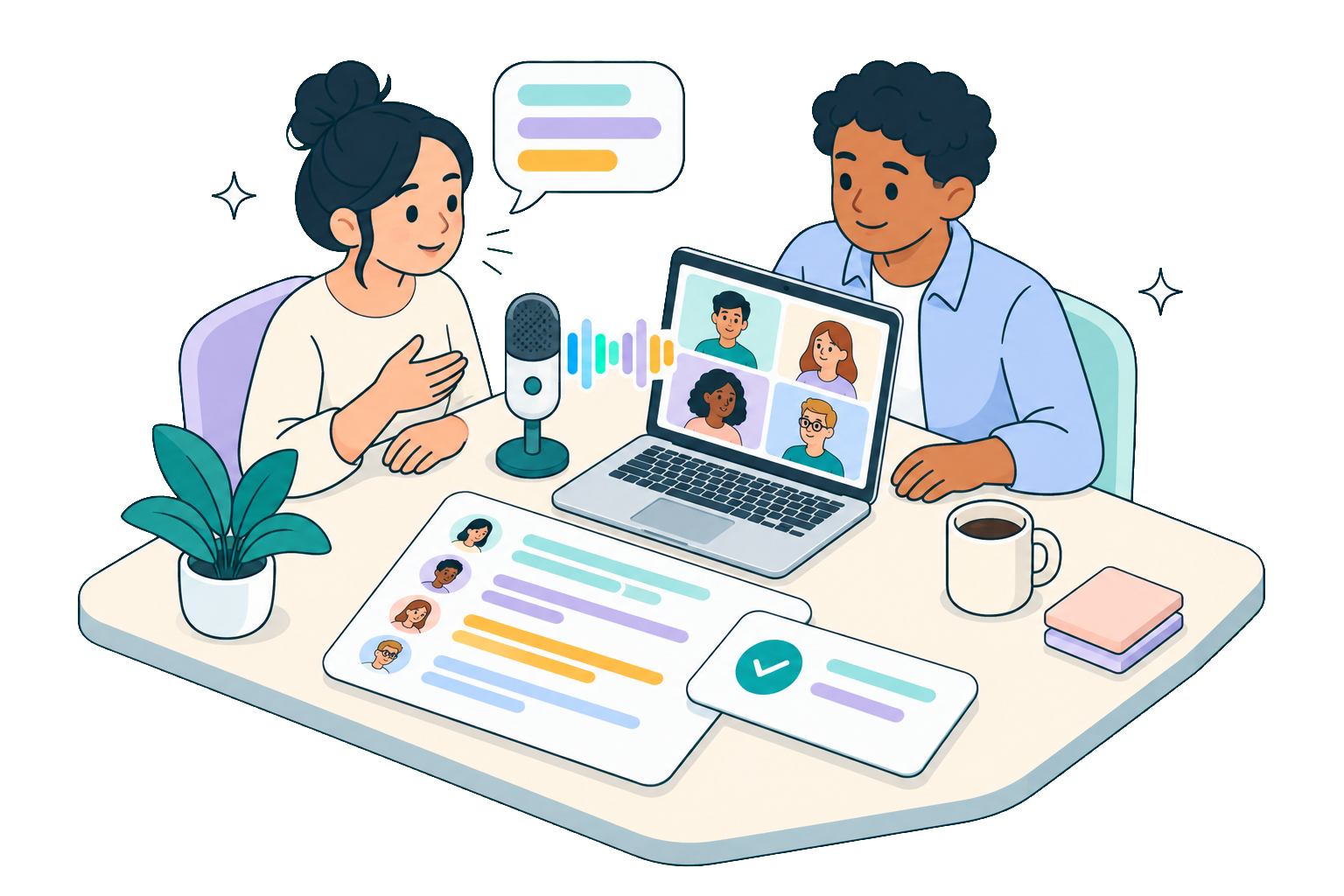
Communication tools help most when they make follow-up clearer without adding process. A good transcript keeps teams aligned instead of slowing them down.
Steadier continuity across shifts and teams
A written record supports handoffs when several people or departments need the same context after a fast conversation.
Easier review and training
Searchable transcript history lets teams revisit how they communicate and improve their internal workflows over time.
Clearer view for internal coordination
Managers and support staff can read the same record instead of relying on partial retellings from each person.
Plain facts about your data
Connections are encrypted, data is stored in the EU, and audio and transcripts are never used to train models. Sharing is off until you turn it on, and you can export or delete your data yourself from your account.
Feature fit for healthcare communication
These are the jobs care teams usually want a transcript to handle: live coordination, reliable handoffs, and review across more than one language.
Before you record
Kalima runs on your own device, so nobody in the meeting sees it. That is exactly why you should announce it: tell everyone before you start and ask for their consent. If you use Kalima at work, agree on it with your data protection officer and, where there is one, your works council first.
Healthcare teams ask
Common questions from teams looking at transcription for operational communication in care settings, including the limits worth knowing before you start.
Further reading
Related use cases
Support clearer communication in your care team
Start for free and try Kalima in your own healthcare communication workflow.